Monday, June 18, 2012

GREECE ELECTIONS


Antonis Samaras begins urgent Greece coalition talks

Mr Samaras wants a "national salvation government" but Mr Tsipras says he will play no part in it
The leader of the party that narrowly won Greece's election has begun urgent talks to form a coalition, saying he wants to forge a "national consensus".
Antonis Samaras, of the New Democracy party, on Monday met President Karolos Papoulias to be given a formal mandate.
Mr Samaras said he would seek changes in the terms of a bailout agreement reached with the EU and IMF.
The second-place Syriza party has rejected the terms of the bailout and said it would form the opposition.
Mr Samaras said as he met the president: "A national understanding by everybody is imperative."
Under the constitution, Mr Papoulias has given Mr Samaras three days to form a government.
Mr Samaras said he believed he could form a working coalition.

Analysis

The main parties do not seem to be in the mood to hang around and haggle. Everyone expects a government to be formed quickly - but this is Greece so let's wait until the signatures are on paper.
The big problem they face? New Democracy and Pasok are blamed by many Greeks for running the corrupt governing system that got the country into a mess in the first place.
There is a real crisis of political legitimacy at the moment and many people only voted for New Democracy through gritted teeth. Senior party officials I've spoken to say the best way to restore some credibility is to act quickly and efficiently. But many of the measures they will need to push through will be deeply unpopular.
All of this plays into the hands of Syriza, sitting pretty in opposition. Street protests can be expected. Remind me again - who really won the election? One proposal to blunt Syriza's message is to hold a referendum on whether Greece should stay in the euro and stick with the bailout plan. This would be a gamble. But that is when people would really have to decide.
Mr Papoulias said there was "a categorical imperative to form the government" immediately.
"The country cannot remain ungoverned for even an hour," he said.
'Best guarantee' Mr Samaras met the leader of Syriza, Alexis Tsipras, after talking to the president.
Mr Tsipras said Syriza would remain in opposition and challenge the government, as his party had "different priorities".
"The role of a strong and responsible opposition... is to intervene in a powerful way and this is what I assured Mr Samaras that we would do."
However, he said Syriza would not be an obstacle to the formation of a government by New Democracy, which he said was in accordance with the mandate of the people.
Despite Mr Tsipras's opposition, Mr Samaras said: "We need a national salvation government with as many parties as possible."
Mr Samaras will meet the leader of the socialist Pasok party, Evangelos Venizelos, in the afternoon.
Those two parties should be able to form a majority coalition, but the BBC's Mark Lowen in Athens says Mr Samaras wants the broader grouping to try to create a stable government with a stronger popular mandate.
European leaders cautiously welcomed the Greek election results
With almost all ballots counted, New Democracy has 29.7% of the vote (129 seats), Syriza 26.9% (71) and Pasok 12.3% (33).
There are 300 seats in parliament and Greece has a rule that gives the leading party 50 extra seats.
However, correspondents point out that only 40% of voters backed parties that broadly support the bailout deal with the EU and the IMF.
Nevertheless, many world leaders hailed the election result.

Bailout deal - Greek pledges

  • Cut 15,000 state sector jobs this year - aiming for 150,000 to be cut by 2015
  • Cut minimum wage by 22%, to about 600 euros a month
  • Pension cut worth 300m euros this year
  • Spending cuts of more than 3bn euros this year
  • Liberalise labour laws to make hiring and firing easier
  • Boost tax collection
  • Carry out privatisations worth 15bn euros by 2015
  • Open up more professions to competition, eg in health, tourism and real estate
  • Greece aims to cut its debt burden to 116% of GDP by 2020
In a statement on behalf of the 17 eurozone finance ministers, Luxembourg Prime Minister Jean-Paul Juncker said that "continued fiscal and structural reforms are Greece's best guarantee to overcome the current economic and social challenges and for a more prosperous future of Greece in the euro area".
German Chancellor Angela Merkel telephoned Mr Samaras to congratulate him on his victory, while the US said it was in everyone's interests "for Greece to remain in the euro area".
Our correspondent says Mr Samaras will push for a lightening of the bailout terms from Brussels, arguing that Greeks have accepted more pain by electing a pro-bailout party and that Europe should now cut Greece some slack.
German Foreign Minister Guido Westerwelle said the substance of the bailout was non-negotiable, although the timeframe could be discussed.
However, another spokesman for the German government, Georg Streiter, said Greece should "stick to its agreements and fully implement the agreed reforms. Now is not the time for any kind of discounts to Greece".
Although the market response to the election victory was mixed, European banking stocks fell sharply. Germany's Commerzbank was down 3% and France's BNP 2%, with analysts saying much uncertainty remained.
Graphic

Ethiopia makes progress in ending preventable child deaths

Saudi Arabia desirous to boost trade ties with Ethiopia

Saudi Arabia desirous to boost trade ties with Ethiopia

Saudi Arabia desirous to boost trade ties with Ethiopia

Ethiopia 1 Benin 1 - Ethiopia advance to final round of ACN qualifiers!

Ethiopian Women football team and Tanzania's will play today

French Presidential Election 2012

The G20 Mexico Summit

Tensions High in Egypt Ahead of Presidential Election

How Greece's Election Could Shape Global Economy

Friday, June 15, 2012

LONDON 2012 OLYMPIC


London Olympics: athletes who refuse to compete will be 'heavily punished'

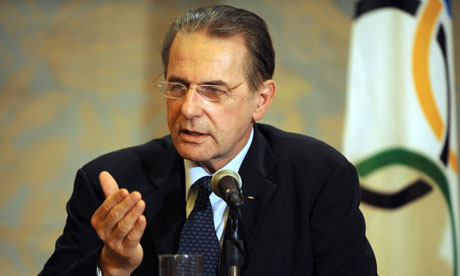
Warning from IOC president Jacques Rogge comes after Algerian athlete withdrew from event against Israeli rival

    Jacques Rogge
    Jacques Rogge, the International Olympic Committee president, said only serious injury would be accepted as an excuse for not competing. Photograph: Roslan Rahman/AFP/Getty Images
    The head of the International Olympic Committee has warned that any athlete not prepared to compete against a rival nation for political or religious reasons in London will be heavily punished.
    The intervention of the IOC president, Jacques Rogge, comes after an Algerian athlete withdrew from a race against an Israeli rival during a recent World Cup canoeing regatta in Duisburg, Germany.
    Rogge said that all 200-plus nations that will be represented in London had been warned that only serious injury would be accepted as an excuse for not competing, and that sanctions would be taken against any athlete who pulled out of a competition for other reasons. Suspicious withdrawals will be examined by a panel of medical experts.
    "We have just told all the national Olympic committees that we expect all the athletes to respect the schedule of competition and not to pull out without a good reason for competition against an athlete of another country," he told the Guardian.
    "If nation A does not appear at the competition against nation B we will ask for explanations. If the explanation is not satisfactory and valid at the end of it and is not credible then we will go into cross-examination by an independent medical board. And if the medical board says it is not a genuine reason then sanctions will be taken. That is quite clear."
    The IOC has reminded its members of their responsibilities in the wake of an incident in which Algerian kayaker Nasreddine Baghdadi stopped paddling and returned to the dock during a 1,000 metre heat that included an Israeli competitor, Roei Yelling.
    He refused to comment afterwards, but it was later confirmed that he was did so due to pressure from the Algerian government. He returned to competition the next day in the 200m heats.
    The head of the Algerian Olympic Committee, Rachid Hanifi, has said it will be up to the Algerian government whether its athletes should compete against Israelis at the Games.
    "I know it's a very sensitive question and this is why I said that I will discuss it with the Algerian government, conforming to the recommendations of the IOC, which advocates harmonious co-operation between national Olympic committees and their government," Hanifi told the Associated Press last week.
    During the 2004 Games in Athens and the 2008 Olympics, Iran faced criticism after its athletes withdrew from events against Israelis.
    "If you think about rugby, you have this wonderful sentence where England and Scotland think about each other as the 'auld enemy'. But they still play every year," said Rogge.
    The IOC has reminded its member nations that failure to compete because of a rival's religion or nationality would be a breach of its code of ethics and in contravention of the spirit of the Olympic charter.
    In the wake of a string of selection controversies involving Team GB, Rogge also said he believed countries should move to a more objective system for selecting their athletes that would give rise to fewer appeals.
    The most high profile case has been in taekwondo, where world number one, Aaron Cook, has threatened to go to court after the British Olympic Association refused to overturn his omission, but there has also been controversy in fencing, judo, diving, wrestling and other sports.
    Rogge, a former Olympic sailor, said that when he was chef de mission for the Belgian Olympic team, he insisted that the selection of athletes should be decided on clear and transparent criteria rather than left to subjective opinion.
    "It is the responsibility of the national Olympic committee ultimately to decide on the selection of athletes. I was a chef de mission for five Olympic Games and in charge of selection for my NOC. I had come as an athlete from a system where the selection was rather subjective. I found that a bit unfair," he said.
    "So when I became team leader, I issued a very strict rule that it should be totally objective, a little bit like the American trials. You pass the post first, you're selected. If you're ill or injured, too bad. We had a rule that said you had to be in the top of eight of the world, with room for a very little amount of interpretation. I would not interfere in the business of the BOA, but my personal feeling is that the more objective you are, the less controversy you have."

CAMEROON CAUTIONS

Cameron promises no negotiations over Falkland Islands

Help
UK Prime Minister David Cameron has pledged to protect the Falkland Islands' sovereignty against Argentinian claims to the area.
During a Falkland Islands Government reception in London, the prime minister said there would be "absolutely no neogitation" over sovereignty rights.
Mr Cameron added that it should be left up to the people of the Falklands "to determine their own future".

National World Desi Politics Election 2012 Crime Money The Week Photos Columnists News Blogs Sports Gossip Entertainment Events New York Opinion Life & Style Photos Services Afghan neighbors try to tackle post-NATO withdrawal issues Fourteen of Afghanistan's neighbors and regional powers met in that country's capital to discuss its future after the withdrawal of NATO forces in 2014. Afghan President Hamid Karzai said the head of his government's peace council will travel soon to Saudi Arabia and Pakistan to seek the two nation's help in talking peace with the Taliban. Thursday, June 14th 2012, 06:22 AM Tweet StumbleUpon Tumblr Digg Reddit Email Afghan President Hamid Karzai takes a question during a press conference at the presidential palace in Kabul, Afghanistan, Tuesday, June 12, 2012. The Associated Press Afghan President Hamid Karzai takes a question during a press conference at the presidential palace in Kabul, Afghanistan, Tuesday, June 12, 2012. Afghanistan's neighbors and regional heavyweights met in Kabul on Thursday to do something they rarely do — try to tackle common threats and problems together. With NATO's combat mission ending in 2014, the region's countries are being called on to help stabilize Afghanistan by joining forces to resolve regional problems such as extremism, drug-trafficking, poor coordination on economic issues and, most importantly, terrorism. Any cooperation, however, is bound to share the stage with longtime neighborhood rivalries, the ongoing war in Afghanistan and a fragile effort to reach a peace accord with the Taliban. In opening the one-day conference, Afghan President Hamid Karzai said the head of the government-appointed peace council will travel soon to Saudi Arabia and Pakistan to seek the two nation's continued help in talking peace with the Taliban in hopes of ending decades of war. Karzai said that successful peace discussions with the Taliban are one of the most important elements in attaining harmony in the region. The Afghan leader, who has pushed neighboring Pakistan to do more to help further the peace process, thanked Saudi Arabia for the help it has given in trying to find a political resolution to the war. "We also very much hope that our brothers and sisters in Pakistan will do same," Karzai said. The Taliban have been willing in the past to hold discussions with the United States, but have rejected talks with the Afghan government, although Karzai insists that Taliban leaders have spoken with his government in private. The Taliban have announced their intent to open an office in Qatar. Karzai has backed that plan, but has been pushing Saudi Arabia as a venue for any possible talks. Karzai said that Salahuddin Rabbani, the head of the high peace council, would visit Saudi Arabia and Pakistan in the near future. Rabbani is the son of former Afghan President Burhanuddin Rabbani, who was killed in September 2011 by a suicide bomber who was posing as a peace emissary from the Taliban. Pakistani Foreign Minister Hina Rabbani Khar said Pakistan stood ready to assist with the peace process, but that Afghanistan's various factions need to reach a consensus about a political resolution to the war. Only then, can it be supported by Afghanistan's neighbors, she said. Pakistan has been accused of providing militants sanctuary on its soil and aiding insurgents who attack Afghan and foreign forces in Afghanistan. Afghanistan has been pushing Islamabad to help lure Taliban leaders, who are believed to be holed up or under arrest in Pakistan, to the negotiating table. Pakistan has been under pressure from the United States too. U.S. Defense Secretary Leon Panetta said in a recent visit to Kabul that the U.S. was losing patience with Pakistan and wants it to do more to go after the Taliban, especially the al-Qaida affiliated Haqqani network. "While there are formidable challenges ahead, we must not be consumed by negativity," she said. Khar said Pakistan was committed to fighting for peace. "This is a matter of Pakistan's core national interest," she said. "We in Pakistan know that we cannot grow, that we cannot progress and we cannot live peacefully if our neighbors, particularly and especially our brothers and sisters in Afghanistan, are not growing, are not progressing and are not living peacefully." Iranian Foreign Minister Ali Akbar Salehi boasted of Iran's financial contributions to Afghanistan and expressed support for regional cooperation, especially on drug-trafficking, but also used his speech as a chance to take a jab at the U.S.-led military coalition. "Unfortunately the presence of foreign forces in Afghanistan during the past 10 years has yielded further deteriorating of security, growth and entrenchment of terrorist activities, a surge in narcotic drug production and trafficking, increase in organized crime, the massacre of civilians and destruction of cities and villages," the top Iranian diplomat said. He said Iran welcomed the planned withdrawal of foreign combat troops in 2014 and the decision of some countries to pull out even earlier. Without mentioning the U.S., he said "a particular country" intends to prolong its military presence in Afghanistan in "pursuit of its extra regional objectives." It was clear he was referring to the United States, which plans to keep some troops in Afghanistan after 2014 to train Afghan forces and battle terrorism. "This certainly adds to the security concerns of Afghanistan's neighboring countries," he said, adding that the presence of U.S. troops beyond 2014 could turn Afghanistan "once again into a scene of security rivalries." Thursday's gathering in Kabul is the second meeting of the so-called "Heart of Asia" countries. The first was held in November in Istanbul. The participants include: Afghanistan, Azerbaijan, China, India, Iran, Kazakhstan, Kyrgyzstan, Pakistan, Russia, Saudi Arabia, Tajikistan, Turkey, Turkmenistan, United Arab Emirates and Uzbekistan. Representatives of 15 mostly Western countries and a dozen regional and international organizations are also attending. This article was distributed through the NewsCred Smartwire. Original article © The Associated Press 2012 From NYDailyNews.com ICC rules out window for IPL in FTP - NY Daily News Hum Dil De Chuke... was offered to Bebo first - NY Daily News Apology to help improve ties with Pakistan, says key US senator - NY… Clinton warns Russia over Syria policy - NY Daily News Can't sleep? Here are eight reasons why you're always tired in the… From Around the Web World's Most Beautiful Airports (Travel Channel) US Navy hopes $3 billion stealth ship answers a rising China (Inquirer.net) US military in S. Korea seeks more weaponry (Channel NewsAsia) The 10 Worst Airport Terminals (Frommer's) Iran dont belong in Rio (Iranian.com) [?] MASS ELEPHANT CHRISTENING Pinnawela Elephant Orph

Neighbors try to tackle post-NATO withdrawal issues
Fourteen of Afghanistan's neighbors and regional powers met in that country's capital to discuss its future after the withdrawal of NATO forces in 2014. Afghan President Hamid Karzai said the head of his government's peace council will travel soon to Saudi Arabia and Pakistan to seek the two nation's help in talking peace with the Taliban.


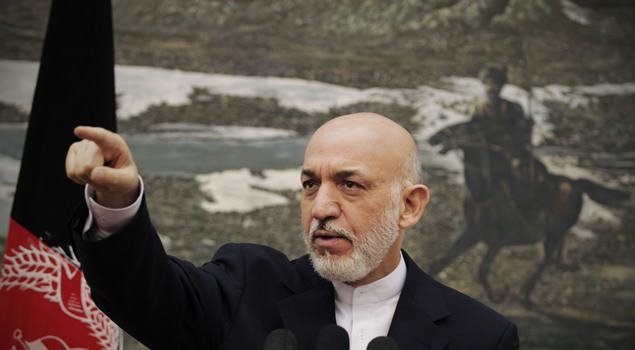
Afghan President Hamid Karzai takes a question during a press conference at the presidential palace in Kabul, Afghanistan, Tuesday, June 12, 2012.
The Associated Press
Afghan President Hamid Karzai takes a question during a press conference at the presidential palace in Kabul, Afghanistan, Tuesday, June 12, 2012.
Afghanistan's neighbors and regional heavyweights met in Kabul on Thursday to do something they rarely do — try to tackle common threats and problems together.
With NATO's combat mission ending in 2014, the region's countries are being called on to help stabilize Afghanistan by joining forces to resolve regional problems such as extremism, drug-trafficking, poor coordination on economic issues and, most importantly, terrorism. Any cooperation, however, is bound to share the stage with longtime neighborhood rivalries, the ongoing war in Afghanistan and a fragile effort to reach a peace accord with the Taliban.
In opening the one-day conference, Afghan President Hamid Karzai said the head of the government-appointed peace council will travel soon to Saudi Arabia and Pakistan to seek the two nation's continued help in talking peace with the Taliban in hopes of ending decades of war.
Karzai said that successful peace discussions with the Taliban are one of the most important elements in attaining harmony in the region. The Afghan leader, who has pushed neighboring Pakistan to do more to help further the peace process, thanked Saudi Arabia for the help it has given in trying to find a political resolution to the war.
"We also very much hope that our brothers and sisters in Pakistan will do same," Karzai said.
The Taliban have been willing in the past to hold discussions with the United States, but have rejected talks with the Afghan government, although Karzai insists that Taliban leaders have spoken with his government in private. The Taliban have announced their intent to open an office in Qatar. Karzai has backed that plan, but has been pushing Saudi Arabia as a venue for any possible talks.
Karzai said that Salahuddin Rabbani, the head of the high peace council, would visit Saudi Arabia and Pakistan in the near future. Rabbani is the son of former Afghan President Burhanuddin Rabbani, who was killed in September 2011 by a suicide bomber who was posing as a peace emissary from the Taliban.
Pakistani Foreign Minister Hina Rabbani Khar said Pakistan stood ready to assist with the peace process, but that Afghanistan's various factions need to reach a consensus about a political resolution to the war. Only then, can it be supported by Afghanistan's neighbors, she said.
Pakistan has been accused of providing militants sanctuary on its soil and aiding insurgents who attack Afghan and foreign forces in Afghanistan. Afghanistan has been pushing Islamabad to help lure Taliban leaders, who are believed to be holed up or under arrest in Pakistan, to the negotiating table.
Pakistan has been under pressure from the United States too. U.S. Defense Secretary Leon Panetta said in a recent visit to Kabul that the U.S. was losing patience with Pakistan and wants it to do more to go after the Taliban, especially the al-Qaida affiliated Haqqani network.
"While there are formidable challenges ahead, we must not be consumed by negativity," she said.
Khar said Pakistan was committed to fighting for peace.
"This is a matter of Pakistan's core national interest," she said. "We in Pakistan know that we cannot grow, that we cannot progress and we cannot live peacefully if our neighbors, particularly and especially our brothers and sisters in Afghanistan, are not growing, are not progressing and are not living peacefully."
Iranian Foreign Minister Ali Akbar Salehi boasted of Iran's financial contributions to Afghanistan and expressed support for regional cooperation, especially on drug-trafficking, but also used his speech as a chance to take a jab at the U.S.-led military coalition.
"Unfortunately the presence of foreign forces in Afghanistan during the past 10 years has yielded further deteriorating of security, growth and entrenchment of terrorist activities, a surge in narcotic drug production and trafficking, increase in organized crime, the massacre of civilians and destruction of cities and villages," the top Iranian diplomat said.
He said Iran welcomed the planned withdrawal of foreign combat troops in 2014 and the decision of some countries to pull out even earlier. Without mentioning the U.S., he said "a particular country" intends to prolong its military presence in Afghanistan in "pursuit of its extra regional objectives." It was clear he was referring to the United States, which plans to keep some troops in Afghanistan after 2014 to train Afghan forces and battle terrorism.
"This certainly adds to the security concerns of Afghanistan's neighboring countries," he said, adding that the presence of U.S. troops beyond 2014 could turn Afghanistan "once again into a scene of security rivalries."
Thursday's gathering in Kabul is the second meeting of the so-called "Heart of Asia" countries. The first was held in November in Istanbul.
The participants include: Afghanistan, Azerbaijan, China, India, Iran, Kazakhstan, Kyrgyzstan, Pakistan, Russia, Saudi Arabia, Tajikistan, Turkey, Turkmenistan, United Arab Emirates and Uzbekistan. Representatives of 15 mostly Western countries and a dozen regional and international organizations are also attending.


USA IN AFRICA

US President Barack Obama unveils US Africa strategy

US President Barack Obama sits with Ghana President John Atta Mills, right, and President Yayi Boni of Benin during a luncheon on food security at the G8 Summit in May 2012 Mr Obama's strategy is partly aimed at encouraging the US and Africans to do business together
The White House has announced a new US strategy for sub-Saharan Africa, which focuses on the continent's economic potential.
It also explores issues related to democracy, security and development.
President Barack Obama said African democracy had improved but corruption was endemic in many countries and state institutions were weak.
The strategy comes as China's presence on the continent continues to grow through investment and trade.
Mr Obama said he would work with Congress to develop preferential trade agreements with African countries, while fighting al-Qaeda and its affiliates on the continent.
"As we look toward the future, it is clear that Africa is more important than ever to the security and prosperity of the international community, and to the United States in particular," said Mr Obama, the US-born son of a Kenyan man.
Exchanging entrepreneurs The White House said its new Strategy Toward Sub-Saharan Africa provides "a proactive and forward looking vision grounded in partnership".
A bid to increase trade and investment in sub-Saharan Africa is among its aims.

Start Quote

Africa offers the highest rate of return on foreign direct investment of any developing region in the world”
Hillary Clinton US secretary of state
The US administration is reaching out to entrepreneurs through exchange programmes. It will try to match US and Africa companies for business opportunities.
The strategy is the result of four months of work, during which advisers looked at how to address the challenges the continent faces from famine to instability as well as the continent's economic potential.
The BBC's Kim Ghattas in Washington says the strategy is partly aimed at encouraging the US and Africans to do business together.
Our correspondent says this approach could also provide an opportunity to help revive the flagging economy in the US.
The announcement indicates a renewed focus on Africa, but as the plan is short on detail for now it is unclear how the strategy differs from what the administration has been doing so far, she says.
Some African countries already enjoy trade preferences with the US - through the Africa Growth and Opportunity Act (Agoa) - on the condition they uphold free elections and markets.
At an Agoa forum in Washington on Thursday, US Secretary of State Hillary Clinton said that Africa was the "land of opportunity".
"I want all of my fellow American citizens, particularly our business community, to hear this: Africa offers the highest rate of return on foreign direct investment of any developing region in the world," AFP news agency quotes her as saying.
Last month, Mr Obama announced a $3bn (£1.9bn) plan to boost food security and farm productivity in Africa.
US officials said that initiative was aimed at alleviating shortages as world food supplies are being stretched by rising demand in Asia's emerging markets.

EGYPTIANS POLITICS

Egypt's Muslim Brotherhood warn of 'dangerous' days

An Egyptian protester raises his clinched hands with chains as he shouts slogans during a protest against presidential candidate Ahmed Shafiq outside the Supreme Constitutional Court in Cairo on June 14, 2012 Protesters reacted with anger to Thursday's Supreme Court ruling
The Muslim Brotherhood has warned that Egypt's fragile democratic gains are under threat, after a surprise court ruling overturned last year's parliamentary elections.
Egypt could see "dangerous" days ahead if power is returned to those linked to the previous regime, it said.
The group's candidate, Mohammed Mursi, faces ex-PM Ahmed Shafiq in a runoff presidential election this weekend.
The decision by the Supreme Court on Thursday plunged Egypt into turmoil.
The court said last year's parliamentary vote - the first free and fair poll in decades - was unconstitutional, and called for fresh elections.
The decision effectively puts legislative power into the hands of the ruling Supreme Council of Armed Forces (Scaf), who were tasked with overseeing Egypt's transition after the toppling of President Hosni Mubarak in February 2011.
The court also upheld the right of Mr Shafiq to run for president.
'Wiped out'

Some Brotherhood activists express hope that the situation can be turned to their advantage amid public suspicion that the ruling Supreme Council of Armed Forces and remnants of the former government are trying to stay in power.
Yet many analysts believe that the court decisions now make a win for Mr Shafiq even more likely. The former air forces commander is widely seen as the unofficial candidate of the generals who took power after President Mubarak was forced from office in February 2011.
Whichever man wins will inherit a difficult security situation, a struggling economy and a nation that now seems bitterly divided.
Activists, who fear Scaf is trying to increase its power, have denounced Thursday's rulings as a "coup" designed to undermine the revolution, carried out by judges appointed under former President Mubarak.
The BBC's Jon Leyne in Cairo says that while judges were expected to rule that some parts of the parliamentary poll was illegitimate, the court went much further by ordering a complete re-run.
In a statement, the Muslim Brotherhood - which won 46% of seats in parliament - said the decisions indicated Egypt was heading into "very difficult days that might be more dangerous than the last days of Mubarak's rule".
"All the democratic gains of the revolution could be wiped out and overturned with the handing of power to one of the symbols of the previous era," it said.
Mr Mursi said he was dissatisfied but accepted the court's rulings.
"I respect the decision of the Supreme Constitutional Court in that I respect the institutions of the state and the principle of separation of powers," he told Egyptian TV, according to AFP.

Who is in charge?

  • Military council, known as Scaf, has run Egypt since Hosni Mubarak's fall in February 2011
  • Parliament: Elected between November 2011 and January 2012. Dominated by Muslim Brotherhood but declared illegitimate by Supreme Constitutional Court
  • Presidency: second round between Islamist Mohammed Mursi and former Mubarak PM Ahmed Shafiq to go ahead on 17 June. President will be elected with no constitution in place
  • Supreme Constitutional Court: highest judicial power; judges appointed under Hosni Mubarak
But in a later speech he appealed to voters, with a warning that the country was at a turning point.
"A minority are trying to corrupt the nation and take us back. We will go to the ballot box to say no to those failures, those criminals."
Other political figures hit out at the ruling, warning that the decision would leave the incoming president without a parliament or a constitution.
Islamist Abdul Moneim Aboul Fotouh, who took part in the first round of the presidential vote in May, said that dissolving parliament amounted to "a total coup, anyone who imagines that the millions of youths will let this pass is dreaming".
The Salafist Al-Nour party, which has the second biggest representation in parliament, said the ruling showed "a complete disregard for the free will of voters".

Start Quote

Egypt just witnessed the smoothest military coup”
Hundreds of protesters gathered in Cairo's Tahrir Square after the announcement to express their anger.
However, correspondents said the real measure of anger will be tested after prayers on Friday, when demonstrations are usually held.
US Secretary of State Hillary Clinton told reporters "there can be no going back on the democratic transition".
'Historic ruling' Meanwhile, Mr Shafiq told supporters that the court had made a "historic ruling and verdict that meant there was no way for anyone to do particular laws for particular people".
The Scaf held an emergency meeting after the two court rulings and later confirmed that the election would go ahead as planned, and urged Egyptians to vote.
Ahmed Shafiq at a news conference, June 3, 2012 Ahmed Shafiq was the last prime minister under Hosni Mubarak
But uncertainty about the intentions of the military had already been raised on Wednesday when the justice ministry announced that army personnel would have the right to detain civilians during the election period.
The court had been considering the validity of the parliamentary election, because some of the seats were contested on a proportional list system, with others on the first-past-the-post system.
It decided that the election law had allowed parties to compete for the one third of seats reserved for independent candidates.
The head of the supreme court Farouk Soltan told Reuters: "The ruling regarding parliament includes the dissolution of the lower house of parliament in its entirety because the law upon which the elections were held is contrary to rules of the constitution."

More on This Story

Egypt votes

Thursday, June 14, 2012

Top 10 Great Historic Speeches

Top 10 Great Historic Speeches

ronaldinho vs ronaldo 06/07.

Pele (1990) 2/2

Pele (1990) 2/2

Pelé GREATest BALL TRICK - game played at 1,566 m (5,138 ft) and at 54 d...

World Cup 1990 Final - Germany 1:0 Argentina

Argentina vs Brazil - World Cup 1990 - part 4/7

Nigeria vs Ethiopia 1993 African Nations Cup qualifier

(2012) Tikur Sew - Teddy Afro (HD English version) Ethiopia Music Video ...

Ethiopia vs South Africa Full Match Highlight

Ethiopia 2 Central African Rep. 0 -2014 World Cup Qualifier

Lamebora-ላሜቦራ-2012 new Ethiopia

Fiyorina-Teddy Afro 2012-Fiyorina-Gual Asmara-Plea

UEFA Euro 2012 Poland - Ukraine

Euro 2012 Trailer


Rock-Hewn Churches, Lalibela

The 11 medieval monolithic cave churches of this 13th-century 'New Jerusalem' are situated in a mountainous region in the heart of Ethiopia near a traditional village with circular-shaped dwellings. Lalibela is a high place of Ethiopian Christianity, still today a place of pilmigrage and devotion.

© UNESCO..

Long Description

The rock-hewn churches of Lalibela are exceptionally fine examples of a long-established Ethiopian building tradition. Monolithic churches are to be found all over the north and the centre of the country. Some of the oldest of such churches are to be found in Tigray, where some are believed to date from around the 6th or 7th centuries. King Lalibela is believed to have commissioned these structures with the purpose of creating a holy and symbolic place which considerably influenced Ethiopian religious beliefs.
The 11 medieval monolithic cave churches of this 13th-century 'New Jerusalem' are situated in a mountainous region in the heart of Ethiopia near a traditional village with circular-shaped dwellings. Lalibela is a high place of Ethiopian Christianity, still today a place of pilgrimage and devotion.
Lalibela is a small town at an altitude of almost 2,800 m in the Ethiopian highlands. It is surrounded by a rocky, dry area. Here in the 13th century devout Christians began hewing out the red volcanic rock to create 13 churches. Four of them were finished as completely free-standing structures, attached to their mother rock only at their bases. The remaining nine range from semi-detached to ones whose facades are the only features that have been 'liberated' from the rock.
The Jerusalem theme is important. The rock churches, although connected to one another by maze-like tunnels, are physically separated by a small river which the Ethiopians named the Jordan. Churches on one side of the Jordan represent the earthly Jerusalem; whereas those on the other side represent the heavenly Jerusalem, the city of jewels and golden sidewalks alluded to in the Bible.
It was King Lalibela who commissioned the structures, but scholars disagree as to his motivation. According to a legendary account, King Lalibela was born in Roha. His name means 'the bee recognizes its sovereignty'. God ordered him to build 10 monolithic churches, and gave him detailed instructions as to their construction and even their colours. When his brother Harbay abdicated, the time had come for Lalibela to fulfil this command. Construction work began and is said to have been carried out with remarkable speed, which is scarcely surprising, for, according to legend, angels joined the labourers by day and at night did double the amount of work which the men had done during the hours of daylight.
Like more episodes in the long history of this country, there are many legends about this king. One is that Lalibela was poisoned by his brother and fell into a three-day coma in which he was taken to Heaven and given a vision of rock-hewn cities. Another legend says that he went into exile to Jerusalem and vowed that when he returned he would create a New Jerusalem. Others attribute the building of the churches to Templars from Europe.
The names of the churches evoke hints of Hebrew, a language related to the Hamo-Semitic dialect still used in Ethiopian church liturgies: Beta Medhane Alem (House of the Saviour of the World), Beta Qedus Mikael (House of St Michael) and Beta Amanuel (House of Emmanuel) are all reminiscent of the Hebrew beth (house). In one of the churches there is a pillar covered with cotton. A monk had a dream in which he saw Christ kissing it; according to the monks, the past, the present and the future are carved into it. The churches are connected to each other by small passages and tunnels.
Source: UNESCO/CLT/WHC